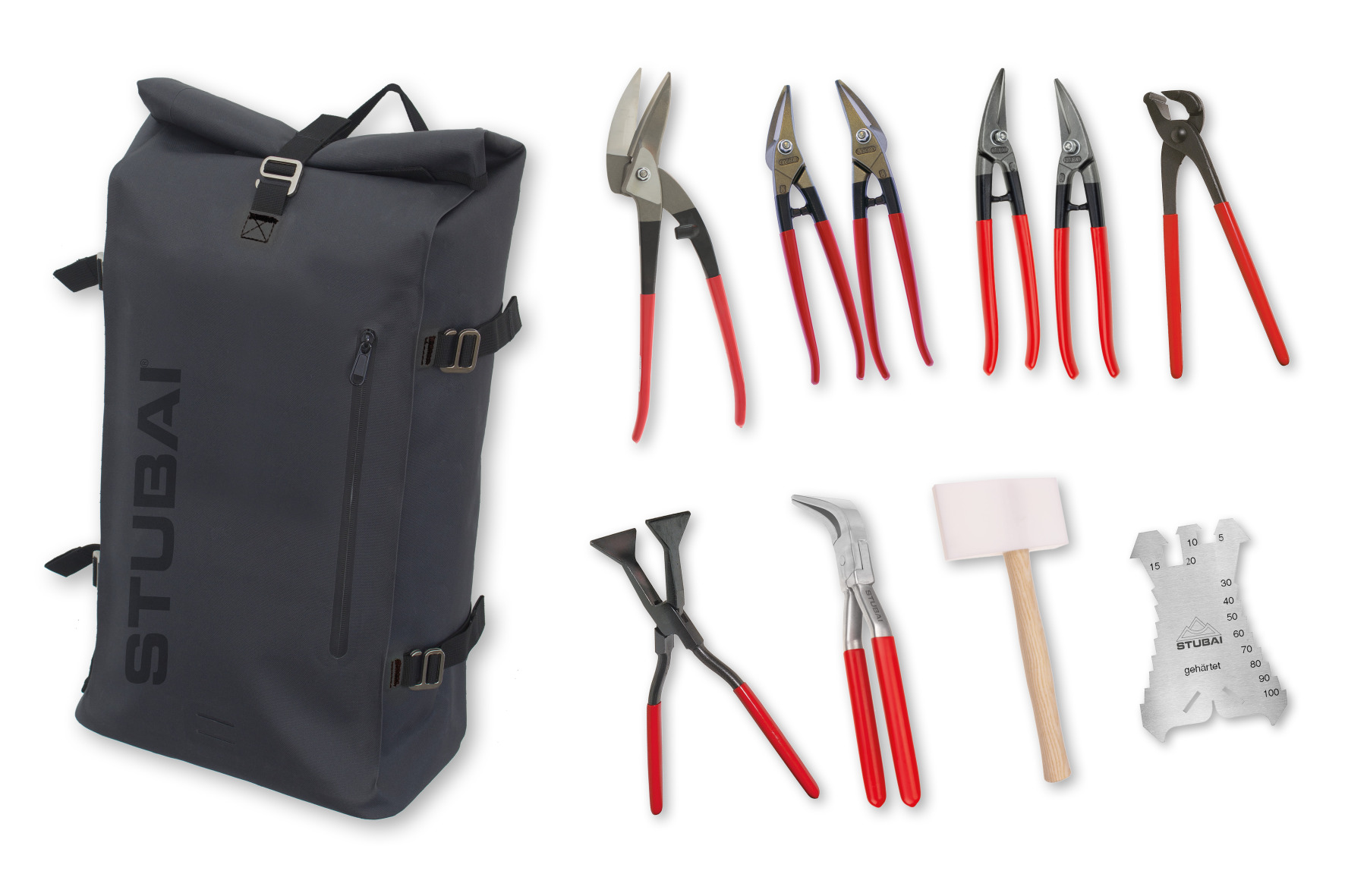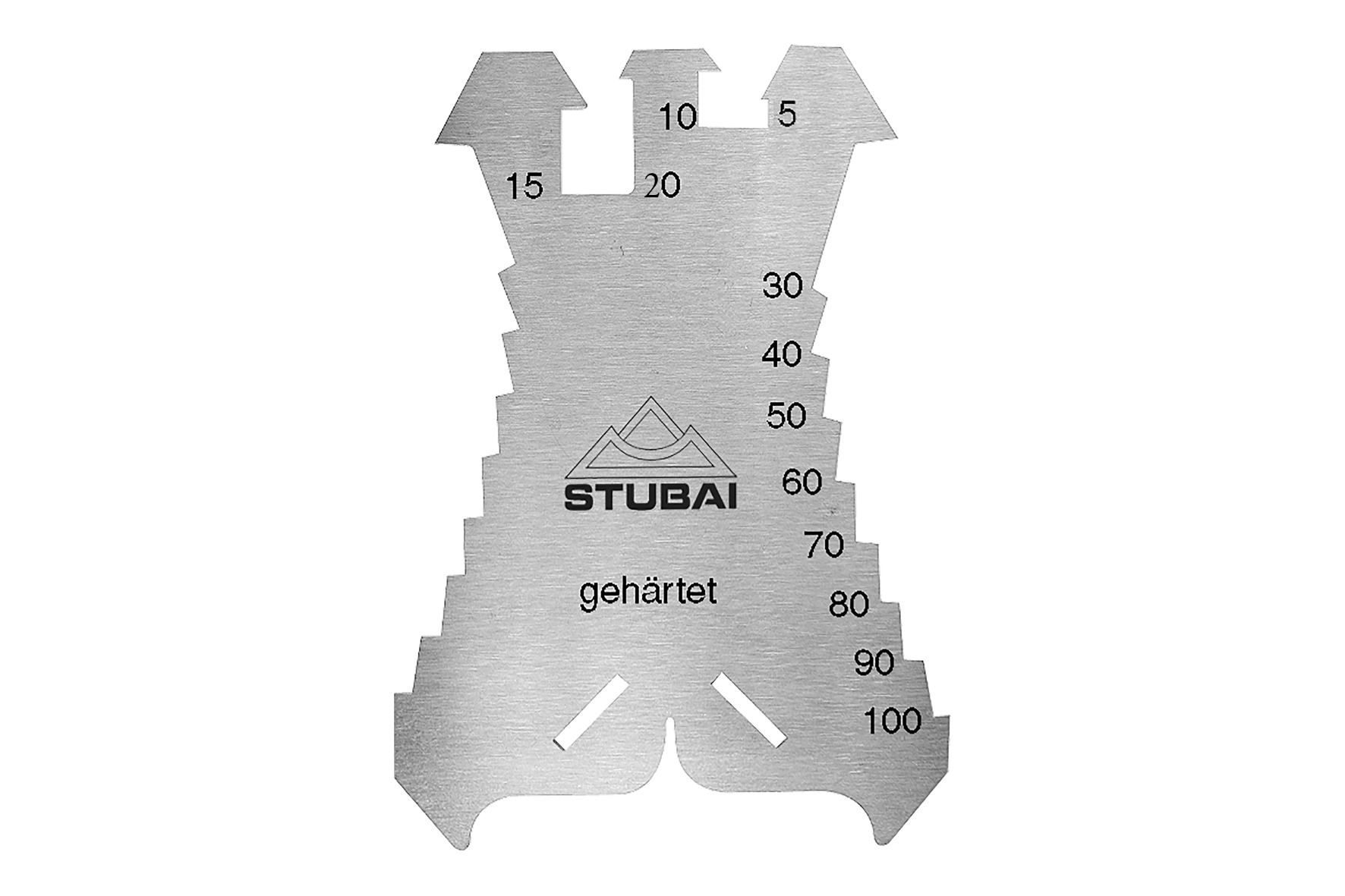
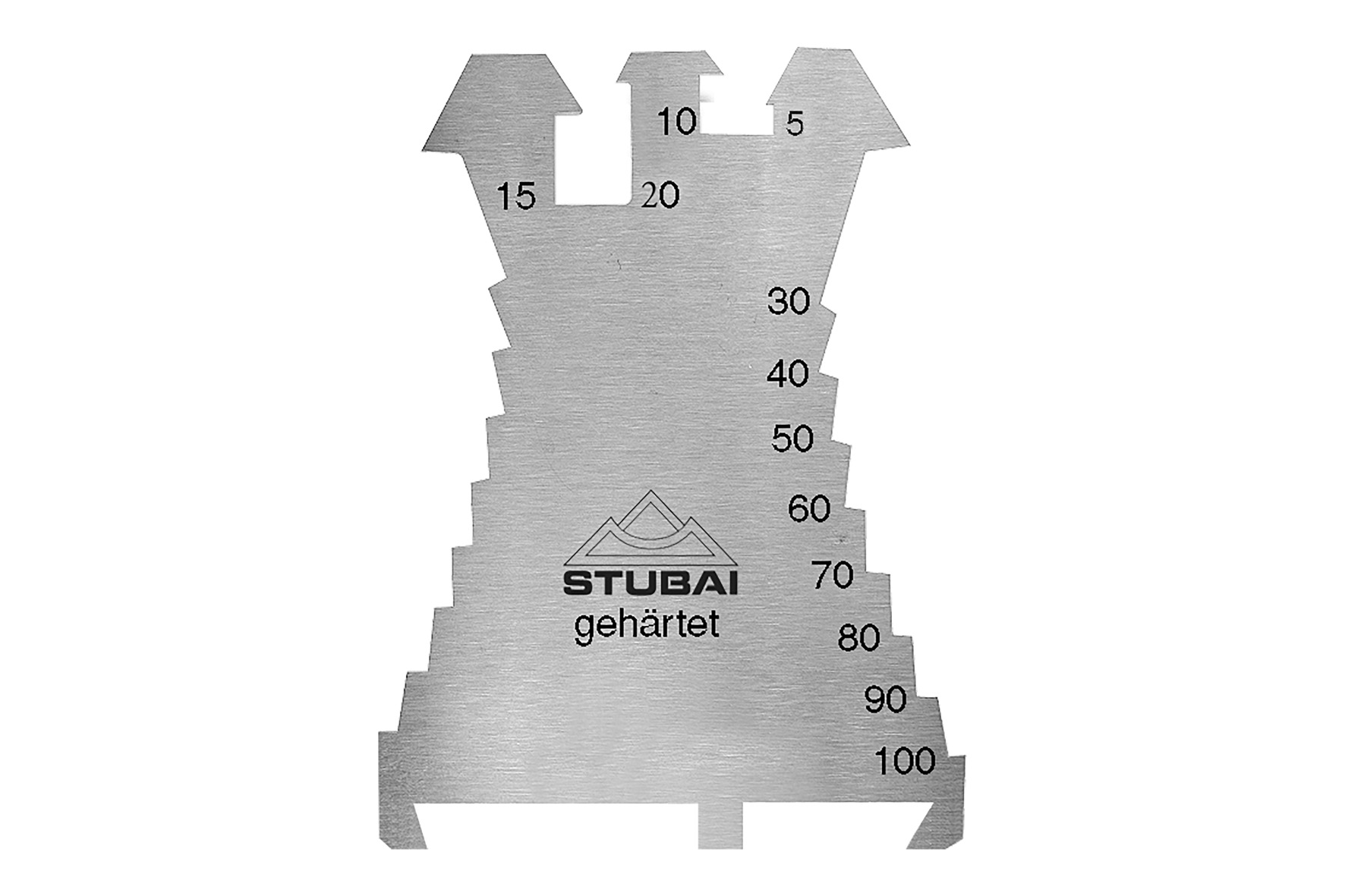
2786 Marking template, hardened, stainless, angular
- Precise scale etched
- Exact graduation every 5 mm from 5 to 100 mm, increasing
- Thickness of material 1,3 mm
- No more bending
- Extended service time of the edges
- Bottom distance: 38 mm + 28 mm.
| Werkstoff | Item No | Designation | Hardness | Weight | Length | Width |
|---|---|---|---|---|---|---|
| Stainless steel | 278602 | Marking template, hardened, stainless 140 mm | 48 HRC | 80 g | 140 mm | 100 mm |
Manufacturer information (GPSR)
MANUFACTURER ACCORDING TO THE EU GENERAL PRODUCT SAFETY REGULATION (GPSR)
STUBAI ZMV GmbH
Dr. Kofler Straße 1
A-6166 Fulpmes
Phone: +43 5225 6960 211
Email: office@stubai.com
Safety Instructions for Marking Tools
General Information:
• Suitable tool: Always use the marking tool specifically designed for the respective task. Using an unsuitable tool increases the risk of accidents and can make the work more difficult.
• Marking tools may only be used by persons with limited physical, sensory or mental abilities, or lacking experience and/or knowledge, if they are supervised by a person responsible for their safety, have received instructions on how to use marking tools, and have understood the resulting hazards.
• Children may only use marking tools if they are over 8 years old and are supervised by a person responsible for their safety, have received instructions on how to use marking tools, and have understood the resulting hazards.
• Keep packaging films away from children; risk of suffocation!
Intended Use:
• Safety is only ensured when the tool is used as intended. Use the tool exclusively for its designated purpose. Incorrect use may lead to tool breakage and injuries. Use pencils, chalks, chalk lines and marking powder exclusively for their intended application.
Improper Use:
• Use for securing or fastening (e.g. with chalk lines) is not permitted.
Inspection Before Use:
• Ensure integrity: Check marking tools before each use for damage such as cracks, loose parts or rust.
• Do not use damaged marking tools: Defective marking tools must not be used and must be taken out of service immediately.
• Avoid dust and powder contact: When working with marking powder, avoid contact with eyes, skin and respiratory passages.
Personal Protective Equipment:
• Wear safety goggles: Use safety goggles to protect yourself from contact with marking powder.
• Wear respiratory protection: Use a dust mask to protect yourself from inhaling marking powder.
Specific Instructions for Pencils and Chalks:
• Use only on suitable surfaces: Use marking pencils and chalks exclusively on materials suitable for marking (e.g. wood, concrete, metal).
• Avoid excessive pressure: Do not apply too much pressure to prevent breaking or damaging the marking tip.
• Store in a dry place: Store pencils and chalks in a dry environment to ensure long-lasting performance.
Specific Instructions for Chalk Lines:
• Check tension: Do not pull the chalk line excessively, as this may cause the line to snap and lead to injuries from recoiling parts.
• Refill marking powder safely: When refilling marking powder, do not overfill and ensure the opening is securely closed to prevent powder leakage.
• Avoid working in windy conditions: Marking powder should not be used in strong wind to minimize dispersion and dust formation.
Specific Instructions for Marking Powder:
• Observe warnings: Check manufacturer information for health or environmental warnings and work in well-ventilated areas.
• Careful handling: Avoid inhaling marking powder, especially if you have sensitive airways. Use protective masks for large-scale applications.
• Store safely: Always store marking powder in tightly sealed containers and protect it from moisture to prevent clumping.
Maintenance, Care and Storage:
• Cleaning after use: After each use, tools must be thoroughly cleaned to remove residues. Dry the tool well.
• Storage: Store tools out of reach of children and persons with limited physical, sensory or mental abilities, in a safe, dry place.
Special Notes:
• Avoid improvisation: Use marking tools exclusively for their intended purpose. Using tools for unsuitable applications may lead to tool breakage or injuries.
• Transporting tools: Ensure that tools are securely fastened during transport to avoid injuries.
This text has been partially translated with the support of AI technology.
STUBAI ZMV GmbH
Dr. Kofler Straße 1
A-6166 Fulpmes
Phone: +43 5225 6960 211
Email: office@stubai.com
Safety Instructions for Marking Tools
General Information:
• Suitable tool: Always use the marking tool specifically designed for the respective task. Using an unsuitable tool increases the risk of accidents and can make the work more difficult.
• Marking tools may only be used by persons with limited physical, sensory or mental abilities, or lacking experience and/or knowledge, if they are supervised by a person responsible for their safety, have received instructions on how to use marking tools, and have understood the resulting hazards.
• Children may only use marking tools if they are over 8 years old and are supervised by a person responsible for their safety, have received instructions on how to use marking tools, and have understood the resulting hazards.
• Keep packaging films away from children; risk of suffocation!
Intended Use:
• Safety is only ensured when the tool is used as intended. Use the tool exclusively for its designated purpose. Incorrect use may lead to tool breakage and injuries. Use pencils, chalks, chalk lines and marking powder exclusively for their intended application.
Improper Use:
• Use for securing or fastening (e.g. with chalk lines) is not permitted.
Inspection Before Use:
• Ensure integrity: Check marking tools before each use for damage such as cracks, loose parts or rust.
• Do not use damaged marking tools: Defective marking tools must not be used and must be taken out of service immediately.
• Avoid dust and powder contact: When working with marking powder, avoid contact with eyes, skin and respiratory passages.
Personal Protective Equipment:
• Wear safety goggles: Use safety goggles to protect yourself from contact with marking powder.
• Wear respiratory protection: Use a dust mask to protect yourself from inhaling marking powder.
Specific Instructions for Pencils and Chalks:
• Use only on suitable surfaces: Use marking pencils and chalks exclusively on materials suitable for marking (e.g. wood, concrete, metal).
• Avoid excessive pressure: Do not apply too much pressure to prevent breaking or damaging the marking tip.
• Store in a dry place: Store pencils and chalks in a dry environment to ensure long-lasting performance.
Specific Instructions for Chalk Lines:
• Check tension: Do not pull the chalk line excessively, as this may cause the line to snap and lead to injuries from recoiling parts.
• Refill marking powder safely: When refilling marking powder, do not overfill and ensure the opening is securely closed to prevent powder leakage.
• Avoid working in windy conditions: Marking powder should not be used in strong wind to minimize dispersion and dust formation.
Specific Instructions for Marking Powder:
• Observe warnings: Check manufacturer information for health or environmental warnings and work in well-ventilated areas.
• Careful handling: Avoid inhaling marking powder, especially if you have sensitive airways. Use protective masks for large-scale applications.
• Store safely: Always store marking powder in tightly sealed containers and protect it from moisture to prevent clumping.
Maintenance, Care and Storage:
• Cleaning after use: After each use, tools must be thoroughly cleaned to remove residues. Dry the tool well.
• Storage: Store tools out of reach of children and persons with limited physical, sensory or mental abilities, in a safe, dry place.
Special Notes:
• Avoid improvisation: Use marking tools exclusively for their intended purpose. Using tools for unsuitable applications may lead to tool breakage or injuries.
• Transporting tools: Ensure that tools are securely fastened during transport to avoid injuries.
This text has been partially translated with the support of AI technology.